How Do You Know When to Switch for Serving in Tennis
In unproblematic terms, the serve is the shot that starts every tennis point. If you lot watch the meridian players, however, it is then much more than that. It tin be an elegant demonstration of coordination, timing, and strength, allowing a player to produce well-nigh bullet-like speed, or astonishing spin.
The greatest servers, exemplified past Ivo Karlovic, win thousands of points during their careers with the accurateness and ability of their serve, and to watch them in action first hand can be genuinely awe-inspiring. If you lot want to effort to emulate these legends, what are the rules you must follow?
The basic tennis serve rules are that players must serve the ball diagonally into the service box across the net. The server must stand backside the baseline when serving and has two chances to hit a practiced serve per point. Tennis serve rules differ slightly between singles and doubles play.
Nether certain circumstances, yous might have to repeat a serve or be awarded the indicate automatically.
Tennis Serve Rules Singles
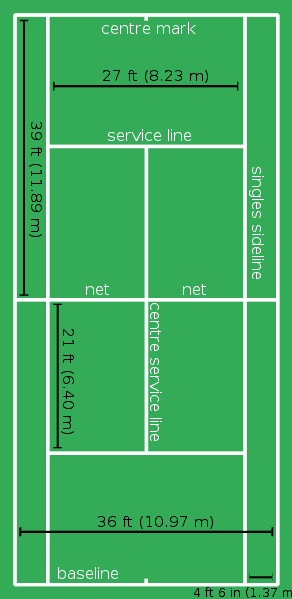
When preparing to serve, you must stand backside the baseline, holding a ball in your non-playing hand. In the middle of the baseline yous will find a minor mark, known imaginatively every bit the 'centre mark'. If an even number of points has been played in a game, yous must stand to the right of this mark when serving. Otherwise, y'all need to stand to the left.
For a serve to be legal, you must release the ball from your non-playing hand (in that location are special rules for people who exercise not have utilise of both artillery), and hit the ball with your racket, earlier information technology hits the ground, over the net. Whatever action is fine, as long as the ball is just struck once.
The ball must land in the 'service box', marked out past the center line, the service line, and the inner, or 'singles', tramline, diagonally opposite the side you are serving from.
If the ball is stopped past the net, or does not land in the service box, it is a 'fault'. If the first serve is a fault, a 2nd serve tin be taken, but the point is lost if the second serve is also a fault.
In one case a service game has been completed, a new server takes over. The server switches more frequently in a tie-break, namely after the first point and every subsequent ii.
Lawn tennis Serve Rules Doubles
The rules for serving in doubles are well-nigh identical to those for singles. Despite the fact that the court is wider for doubles, the service boxes remain the same as for singles.
The only difference for serving in singles vs doubles is that, in doubles, players tin can serve from a position behind the tramlines, as these are now a part of the court. In doubles, the rules for switching servers are the same as for singles, except that, when it is a team's plough to serve, partners take turns to serve every game.
In a tie-interruption, each of y'all volition serve for 2 points (other than the get-go indicate) alternately when it is your squad'southward turn to serve.
Lawn tennis Toss Rules
There are very few tennis rules well-nigh the ball toss. The key point to remember is that the ball is thrown or released with the non-playing hand, and you must hitting information technology before it bounces. If you make up one's mind that the brawl toss is not where yous would have wanted, y'all tin can grab information technology or permit information technology drop and try again without penalization.
Nevertheless, this does not employ if you lot take completed your service action- so if you swung at the ball and missed it, this is a fault.
Players exercise non necessarily need to toss the brawl over their head – they tin can hit underhand serves, which are considered legal (although seen as unprofessional by some players).
Weird Rules – Foot Faults, Lets, & Striking Opponents
There are a few other important rules to exist aware of – and most of them tin exist considered weird for new tennis players.
Firstly, when serving, players must remain behind the baseline until they have hit the ball. If any role of a player'southward torso touches the baseline, or the courtroom in front of it, before they have made contact with the ball, this is a 'foot fault', and is treated the same fashion as whatsoever other service fault.
Of course, foot faults are only likely to exist noticed in umpired matches, but y'all should withal try to avoid them.
Secondly, if the ball strikes the net before it lands in the correct service box, this is a 'let', which just means that the serve does not count and the player can have another try. There is no limit to the number of lets in a game.
Some pundits would like to see this rule abolished, with the returner being obligated to hit the brawl back whether it hitting the cyberspace or not, every bit this would make the game progress faster.
A slightly agreeable oddity is the fact that if a serve hits an opponent earlier it bounces, irrespective of whether it was going to land anywhere near the service box, the server is awarded the point.
This very rarely happens, but tin occur when a miscued serve strikes the returner's partner (usually when they are not concentrating) in a game of doubles.
Final Thoughts
The rules for the serve are pretty simple and logical: stand up behind the baseline, and hit the brawl before information technology bounces into the box diagonally opposite. Nonetheless, information technology pays to know the details as you lot can then make sure that the rules are being followed in matches.
Source: https://mytennishq.com/tennis-serve-rules-the-5-minute-guide/
0 Response to "How Do You Know When to Switch for Serving in Tennis"
Post a Comment