Office Building Architectural Plan Drawing
Overview
Within This Page
- Overview
- Edifice Attributes
- Emerging Issues
- Relevant Codes and Standards
- Additional Resources
The office building is a very tangible reflection of a profound change in employment patterns that occurred over the final one hundred years. In the U.S., northern Europe, and Japan, at least l percent of the working population is employed in role settings every bit compared to 5 percent of the population at the commencement of the 20th century. Withal, today's office buildings are experiencing fifty-fifty more change due to the recent pandemic. The function is now a place for collaboration, talent recruitment, onboarding, and inspiration with new requirements and expectations that combine concrete spaces with technologically supported ways to work, in the role or remotely.
Typically, the life-bike cost distribution for a typical service organization is about iii to four percent for the facility, four percent for operations, one percent for furniture, and ninety to 91 percent for salaries. Equally such, if the part structure can leverage the iii to 4 percent expenditure on facilities to improve the productivity of the workplace, it can have a very dramatic effect on personnel contributions representing xc to 91 percent of the service organization's costs.
To achieve this objective, the office building must benefit from an integrated design approach that focuses on meeting a list of design objectives. Through integrated design, high-performance function buildings offers owners and users increased worker satisfaction and productivity, improved health, greater flexibility, and enhanced energy and environmental performance. Typically, these projects apply life-cycle analysis to optimize initial investments in architectural pattern, systems selection, and edifice construction.
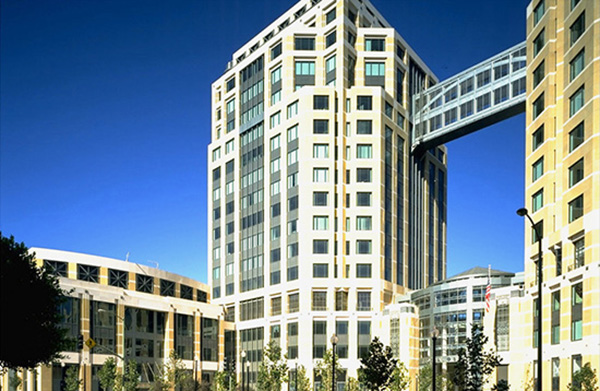
The Ronald 5. Dellums Federal Building and U.Southward. Courthouse complex in Oakland, California, consists of two identical towers topped with pyramid-shaped roofs. The towers are connected by a ground level rotunda and an elevated sky bridge. The podium of one of the towers houses a federal courthouse and the other houses a mail office and briefing eye.
Photo Credit: Kaplan McLaughlin Diaz
Building Attributes
An office building must have flexible and technologically-advanced working environments that are rubber, good for you, comfortable, durable, aesthetically-pleasing, sustainable, and accessible. It must exist able to adapt the specific space and equipment needs of the tenant. Special attention should be made to the selection of interior finishes and art installations, especially in entry spaces, briefing rooms and other areas with public access.
A. Types of Spaces
An office edifice incorporates a number of infinite types to come across the needs of staff and visitors. These may include:
Offices
- Offices: May be private or semi-private acoustically and/or visually.
- Conference Rooms
Employee/Visitor Back up Spaces
- Convenience Store, Kiosk, or Vending Machines
- Anteroom: Primal location for building directory, schedules, and general data
- Atria or Common Space(s): Informal, multi-purpose recreation and social gathering space(southward)
- Cafeteria or Dining Hall
- Individual Toilets, Restrooms, and Showers
- Child Care Centers
- Physical Fitness Surface area
- Interior or Surface Parking Areas
Authoritative Support Spaces
- Administrative Offices: May be private or semi-private acoustically and/or visually.
Functioning and Maintenance Spaces
- General Storage: For items such every bit stationery, equipment, and instructional materials.
- Food Preparation Surface area or Kitchen
- Calculator/Information technology (IT) Closets or data processing areas. See WBDG Automatic Information Processing: PC System related information.
- Maintenance Closets
B. Of import Design Considerations
Typical features of Office Buildings include the list of applicable design objectives elements as outlined below. For a complete listing and definitions of the design objectives within the context of whole edifice design, click on the titles below.
Accessible
The ADA requires that all new construction of places of public accommodation, likewise as of commercial facilities such equally office buildings, be accessible. The ADA Standards for Attainable Design gear up minimum requirements—both scoping and technical—for newly designed and constructed or altered public accommodations and commercial facilities to be readily accessible to and usable by individuals with disabilities. Several of the cardinal elements are outlined below. Nevertheless, it is of import to apply the full standard to determine all requirements.
-
Accessible Parking, Entrances, and Routes: Role buildings should have attainable parking, entrances, and accessible routes within the spaces that can adapt persons with diverse disabilities, including wheelchairs. Office furniture should be placed a minimum of 32" from walls and other obstructions to allow for shine wheelchair passages. Permit lx" clearance so wheelchairs can rotate and turn around corners.
-
Accessible Countertops and Work Stations: Conform dissimilar employee needs through the utilise of standing and/or adjustable desks, and work surfaces and countertops that are modifiable. Desks should be 24–36" high. Standard desks are unremarkably xxx" loftier. Employees should not accept to reach any higher than 48" and no lower than 15". When an employee needs to reach to the side, items should be no higher than 54" and no lower than 9". Contain Universal Design principles to achieve a pattern that works for all whenever possible.
-
Assistive Technology: Programme for employees with disabilities who require special assistive engineering, also every bit employees who use a large amount of engineering that is non portable.
-
Toilet Rooms and Bathing Spaces: Provide accessible toilet rooms and bathing spaces as divers and required by the ADA.
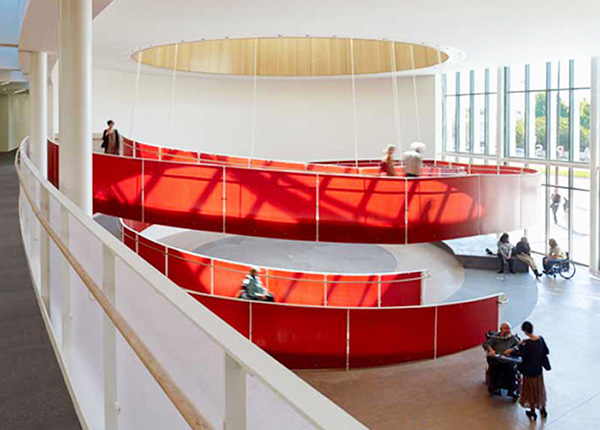
A spiraling ramp with bright red walls at the transit-oriented Ed Roberts Campus in Berkeley, California, designed by Leddy Maytum Stacy Architects, offers an accessible and visually appealing way to movement between floors.
Photo Credit: Tim Griffith
Aesthetics
-
Planning: When planning the exterior and interiors of an role building, create a building blueprint and spaces that businesses and people want to piece of work in. Aesthetics are extremely pregnant to both morale and productivity within the workplace. The office building should besides be planned to arrange changes in employ or piece of work catamenia.
-
Overall Aesthetics: Utilize colour, pattern, and texture in the building to create an inviting and safe environment. Furnishings, finishes, and artwork should reflect the nature of the piece of work within the edifice and be well taken care of and provide supportive and comfy environments. Provide access to views and nature whenever possible to meliorate the quality of the work surround. Provide aesthetically pleasing private work spaces and storage. Encourage some personalizing of space, simply eliminate ataxia to reduce distractions and piece of work hazards.
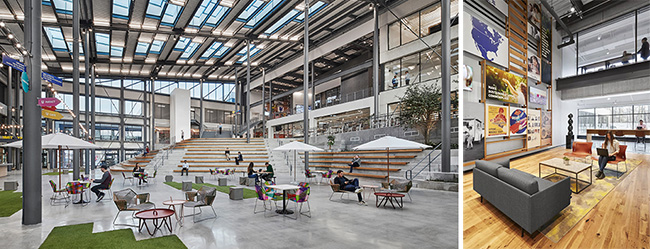
The North American headquarters of consumer appurtenances company Unilever, was overhauled by Perkins + Will with new communal areas to create a showpiece part that incorporates smart engineering, is sustainable and Instagram-gear up, and makes employees feel like they are in Manhattan. Traditional, cellular layouts were replaced with open up workspaces, huddle rooms, and lounges.
Photo Credits: Perkins+Will
Cost-Effective
The high-performance office should be evaluated using life-bicycle economic and material evaluation models. Owners need to understand that optimizing building performance requires a willingness to invest more than initially to relieve on long-term operations and maintenance costs.
To accomplish the optimum functioning for the investment in the facility, value applied science provides a means for assessing the functioning versus toll of each design element and building component. In the blueprint stage building development, properly applied value engineering considers alternative design solutions to optimize the expected cost/worth ratio of projects at completion. Value engineering elicits ideas on ways of maintaining or enhancing results while reducing life-cycle costs. In the structure phase, contractors are encouraged through shared savings to draw on their special 'know-how' to propose changes that cutting costs while maintaining or enhancing quality, value, and functional functioning. For more information on value-engineering, see WBDG Cost-Effective—Apply Cost and Value Engineering Throughout the Project Life Cycle.
Functional/Operational
Tenant Requirements: The edifice design must consider the integrated requirements of the intended tenants. This includes their desired epitome, caste of public access, operating hours, growth demands, security bug, and vulnerability assessment results, organization and grouping sizes, growth potential, long-term consistency of demand, group associates requirements, electronic equipment and technology requirements, acoustical requirements, special floor loading and filing/storage requirements, special utility services, whatever material treatment or operational procedure flows, special wellness hazards, use of vehicles and types of vehicles used, and economic objectives.

Office layouts have become more than open up, supporting opportunities for easy collaboration, access to technology, and healthy settings that include natural daylight and views.
Photo Credit: Alesia Kazantceva on Unsplash
Flexibility
The high-performance office must easily and economically conform frequent renovation and amending, sometimes referred to as "churn." These modifications may be due to management reorganization, personnel shifts, changes in business models, or technological innovations, just the office infrastructure, interior systems, and effects must be upward to the challenge.
-
Consider raised floors to allow for easy access to cabling and power distribution, as well every bit avant-garde air distribution capabilities to address private occupant comfort.
-
Incorporate features such as plug-and-play floor boxes for power, data, voice and fiber, modular and harnessed wiring and buses, and conferencing hubs to allow for daily flexibility at work also every bit future reorganization of office workstations.
-
Plan for the hybrid function model to allow some employees to work in the office, while others may remain working remotely. Distanced layouts, separated cubicles, more personal infinite, contactless pathways, i-way hallways, distanced desks, disposable surface protectors, and signage to directly the flow of employees and visitors are elements of hybrid role pattern.
Urban and Site Planning
The concentration of a large number of workers within ane edifice can have a significant affect on surrounding areas and neighborhoods. Office structures tin can vitalize neighborhoods with the retail, nutrient service, and interrelated business concern links the office brings to the neighborhood. Consideration of transportation issues must also be given when developing office structures. Function buildings are often impacted by urban planning and municipal zoning, which attempt to promote compatible state apply and vibrant neighborhoods.
-
Consider previously developed sites or brownfield sites for the development of a new office building to reduce the impact on land utilise and natural habitats. Also, consider existing buildings that tin can be retrofitted to reduce the use of resources needed to create a new building while also minimizing the disturbance of new sites.
-
When selecting office locations, consideration should exist given to the travel altitude the majority of occupants will accept to achieve the office. Studies including nothing code origination should be conducted to determine the best location for the office. The evolution of new office locations may necessitate relocation of employees, particularly if the part is moved or opened in a new geographical area. Consideration of the municipal resource should include housing costs and availability, traffic congestion, school arrangement quality, cultural resource such every bit museums, sports teams, and institutions of higher education, natural attractions such as coastal, riverfront, and lakefront areas, mountains, and public parks, availability of educated labor, crime charge per unit and constabulary enforcement, and civic infrastructure capacity such every bit h2o, waste water, and waste processing.
-
One time a edifice has been constructed and occupied, it is critical that long-term functioning exist optimized through an aggressive process of metering, monitoring, and reporting. The results of this feedback should inform maintenance operations and be bachelor every bit input to new design efforts.
Productive
Worker Satisfaction, Wellness, and Comfort: In role environments, the single greatest cost to employers is the salaries of the employees occupying the space. Information technology generally exceeds the charter and energy costs of a facility by a factor of x on a square pes basis. For this reason, the health, rubber, and comfort of employees in a high-operation office are of paramount business.
-
Utilize strategies such as increased natural ventilation rates, the specification of non-toxic and low-polluting materials and systems, and indoor air quality monitoring.
-
Provide individualized climate control that permits users to set their own, localized temperature, ventilation rate, and air movement preferences.
-
Information technology is widely accepted that worker satisfaction and operation increases when role workers are provided stimulating, dynamic working environments. Access to windows and views, opportunities for interaction, and control of one's firsthand environment are some of the factors that contribute to improved workplace satisfaction. Encounter as well the Psychosocial Value of Space.
-
Natural light is important to the health and psychological well-existence of office workers. The pattern of function environments must place emphasis on providing each occupant with access to natural light and views to the outside. A minimum of 30 foot candles per square foot of diffused indirect natural light is desirable.
-
The acoustical environment of the office must exist designed and integrated with the other architectural systems and furnishings of the office. Special consideration must exist given to dissonance command in open office settings, with absorbent finish materials, masking white dissonance, and sufficient separation of individual occupants.
Technical Connectivity
Technology is an indispensable tool for business, industry, and education. Given that technology is driving a variety of changes in the organizational and architectural forms of office buildings, consider the following issues when incorporating it, especially information technology (It), into an office:
-
Program new part buildings to accept a distributed, robust, and flexible IT infrastructure, which allows technological access in virtually all spaces.
-
During the planning stage, place all necessary technological systems (e.g., phonation/cablevision/data systems such every bit audio/visual systems, speaker systems, Internet access, and Local Expanse Networks [LAN] / Wide-Area Networks [WAN] / Wireless Fidelity [WI-FI]), and provide acceptable equipment rooms and conduit runs for them.
-
Consider and accommodate wireless technologies, as appropriate.
-
Combine smart building technologies, smartphone apps, and wearable sensors to transform the post-pandemic workplace into much safer spaces. Information can as well be captured from these technologies to optimize the spaces and brand them more convenient for users.
-
For existing part buildings, improve admission to the IT infrastructure as renovations are undertaken.
See WBDG Productive—Design for the Changing Workplace and Productive—Integrate Technological Tools for more information about incorporating Information technology into facility blueprint.
Secure / Prophylactic
Function building security begins at the site perimeter or property line. This includes planning for admission to the site, parking, walkways, and security elements that protect the building during the twenty-four hours and at night. Focus the blueprint on protection of occupants and avails against manmade attacks every bit well every bit natural hazards. Through comprehensive threat cess, vulnerability assessment, and run a risk assay, security requirements for private buildings are identified, and advisable reasonable design responses are identified for integration into the role building design.
-
Consider entrances that do not confront uncontrolled vantage points with direct lines of sight to the entrance. Utilize site barriers and setbacks, perimeter barriers and boom resistance, access control, and intrusion detection, entrance screening, package screening and control, open areas that allow for easy visual detection by occupants, and minimized glazing. See WBDG Secure / Rubber—Security for Building Occupants and Assets.
-
Commencement-time visitors, unfamiliar with their surroundings, may have trouble navigating the safest leave route from the building. Consider using increased signage and/or providing safety information and a building directory in welcome brochures. As well, review and evaluate rubber plans on a regular footing. See WBDG Secure / Safe—Burn down Protection and Secure / Safe—Occupant Safety and Health.
-
Utilize CPTED principles to proactively design security into the project without compromising aesthetics, just that also provide cost savings, improved quality of life for building users, and decreased loss and liability.
Bollards installed at an part building perimeter.
Photo Credit: Reliance Foundry
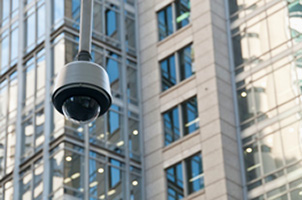
A CCTV surveillance security dome on the exterior of a corporate function building.
Photo Credit: Dreamstime
Sustainable
- Energy Efficiency: Depending on the office's size, local climate, use contour, and utility rates, strategies for minimizing energy consumption include:
- reducing the building's energy loads (by integrating the edifice with the site, optimizing the edifice envelope [decreasing infiltration, increasing insulation], etc.);
- correctly sizing and optimizing the heating, ventilating, and air-conditioning systems;
- installing high-efficiency equipment, lighting, and appliances.
-
Culling Energy: Consideration should be given to the application of renewable free energy systems such equally building-integrated photovoltaic systems that generate building electricity, solar thermal systems that produce hot water for domestic hot water (DHW) or space conditioning, or geothermal heat pump systems that depict on the thermal capacitance of the earth to improve HVAC organisation performance. Boosted consideration should be given to the applications of other distributed energy sources, including microturbines, fuel cells, etc., that provide reliability (emergency and mission critical power) and grid-independence, and reduce reliance on fossil fuel grid ability.
-
Materials and Resources: Building materials and resource should be durable and sustainable to reduce environmental impacts, long-term operations and maintenance costs, and promote indoor environmental quality.
-
Water Efficiency: Incorporate h2o saving fixtures and equipment to protect and conserve h2o. Also plan for landscaping that requires little to no h2o employ. Recover non-sewage and graywater for on-site use (such as toilet flushing and landscape irrigation, and more mostly, consider the water quality requirements of each water apply).
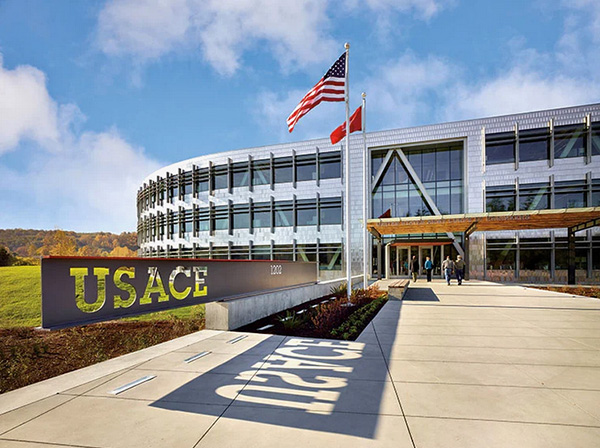
The Federal Eye Southward building transformed a 4.6 acre brownfield site into a highly flexible and sustainable 209,000 SF regional headquarters for the U.S. Ground forces Corps of Engineers (USACE) Northwest District. The project likewise incorporated biophilia to improve the connection to nature and increase worker productivity and happiness.
Photo Credit: Benjamin Benschneider
C. Case Blueprint and Construction Criteria
For GSA, the unit costs for this building type are based on the construction quality and pattern features in the following table . This data is based on GSA'southward criterion interpretation and could exist different for other owners.
Emerging Issues
Modernization
The extensive inventory of facilities that are over 25 years of age present a significant recapitalization challenge likewise as an opportunity. For GSA, its First Impressions Plan addresses the quality of the entrance and entrance hall areas of its older facility portfolio. Central areas of concern for modernization include upgrading the outside envelope, mechanical systems, telecommunication infrastructure, security, and interior finishes. Improving the workplace quality, energy performance, security, flexibility to accommodate tenant churn, maintenance overhead, and life-bike expectancy are of import objectives for modernizing these facilities. Appropriate preservation for buildings on or eligible to be on the historic registry is office of the modernization endeavor.
Commissioning
With the continuation of improved building technologies and controls it is crucial that high-performance buildings are properly commissioned as part of a comprehensive quality balls programme. In many instances, a process of ongoing commissioning has shown to be effective.
Some federal agencies and private institutions are moving aggressively in the management of mandating commissioning for all loftier-performance structures in their portfolios.
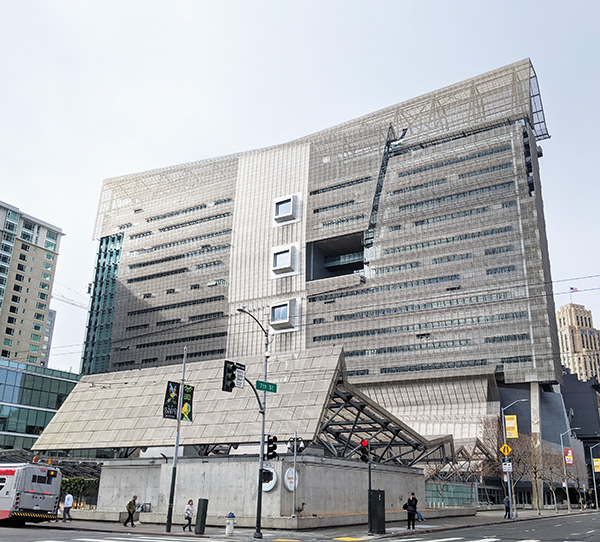
This Federal Edifice in San Francisco, California earned LEED Argent from the USGBC. The building's shape and orientation maximize natural airflow for cooling and ventilation and accept advantage of natural daylight for the majority of the open office interiors.
Photo Credit: Morphosis Architects
Relevant Codes and Standards
There is a wide range of criteria, codes, and standards that encompass federal and private sector office building pattern. General criteria and guidance for office building design for federal facilities tin can be institute in:
- Americans with Disabilities Act (ADA) and Architectural Barriers Deed (ABA) Accessibility Guidelines U.S. Admission Board
- PBS-P100 Facilities Standards for the Public Buildings Service by the General Services Administration (GSA)
- Requirements and Specifications for Special Purpose and Support Space Transmission, Volume i–4 by the General Services Administration (GSA)
- UFC 1-200-01 DoD Building Code
- UFC four-610-01N Authoritative Facilities
- U.S. Courts Blueprint Guide Judiciary Conference
- WELL Building Standard International WELL Edifice Institute
Additional Resource
Organizations and Associations
- The American Institute of Architects (AIA)
- American Social club of Interior Designers (ASID)
- Edifice Owners and Managers Association (BOMA)
- International Facility Managers Clan (IFMA)
- International Living Time to come Institute (ILFI)
- U.South. Dark-green Edifice Council (USGBC)
Publications
- Architectural Graphic Standards, twelfth Edition by The American Institute of Architects, Dennis J. Hall. New York, NY: John Wiley & Sons, Inc., 2016.
- How Buildings Larn past Stewart Brand. New York: Viking, 1995.
- Systems Integration: Increasing Edifice and Workplace Functioning by BOMA International Foundation. 2000.
Others
- Edifice Research Information Knowledgebase (BRIK)—an interactive portal offering online access to peer-reviewed research projects and instance studies in all facets of building, from predesign, design, and construction through occupancy and reuse.
- Energy STAR®
- Zero Energy Buildings
- Loftier-Operation Commercial Buildings—A Technology Roadmap
Tools
- GSA Sustainable Facilities Tool (SFTool)—SFTool's immersive virtual surroundings addresses all your sustainability planning, designing and procurement needs.
Source: https://www.wbdg.org/building-types/office-building
0 Response to "Office Building Architectural Plan Drawing"
Post a Comment